If you’re interested in being a tester for Bearers, join our Discord!
Help us to shape the game!
It has been a busy few months since PAX, and dev Christian has had his nose to the grindstone - polishing, and adding new facets to create a fully realised demo world that should give a holistic view into the vision for Bearers, whilst also allowing a space for more rigorous testing and refinement of the gameplay and balance.
In preparing for the testing phase, the following goals have been the focus -
Remove friction points - Improve communication and design of launching and onboarding in combination with extensive quality of life improvements.
Enemy, mob and level design - Adjusting encounters to create diversity and encourage a more thoughtful and tactical gameplay experience, which is a core tenet of Bearers
Identity of professions - Create a selection of abilities, both active and passive, for each profession, as well as updating the roster of enemies with their own builds and roles, to further exhibit the unique play styles and personalities of the different professions.
Develop an iterable demo level space - Build a tutorial level designed as an ongoing testbed for core gameplay. This space provides the structure needed to quickly add and balance weapons, abilities, and combat systems while gathering player feedback.
Streamlining onboarding, launching, and core quality of life improvements#
One of the key focuses during this phase was ensuring technical hurdles and UX friction wouldn’t prevent players from experiencing what the game actually has to offer. These improvements aim to remove roadblocks so that testers can dive straight into the combat and mechanics that define the experience.
Temporarily removing the EGS account linking requirement means testers/players now launch directly through Steam. The profession selection area has also been adjusted to include targets (dummies) for hands-on weapon testing, whilst providing a clearer explanation of primary profession commitment.
Introduced a dedicated playtest launcher in Steam for quick access. In-game, implemented a full save/load system with auto-saves after each encounter. Co-op connectivity is now streamlined with minimal input required, and online performance has been significantly improved.
Extensive UI/UX improvements focused on clarity and player agency:
Combat feedback - Enemy ability indicators (icons and progress bars) telegraph attacks and help players learn enemy patterns and builds. Capturable abilities now drop as visible orbs. Condition buildup and duration now clearly communicated.
Interface refinement - Comprehensive tooltips, ability capture separated from ability bar, free cursor alongside d-pad navigation, larger ability icons in menus, clearer cooldown animations, improved menu segmentation, and consistent button correlation across UI elements.
Visual clarity - Enhanced selection highlighting and enemy targeting to reduce confusion during intense encounters.
Possibly the most critical focus of this development phase was on crafting distinct battle scenarios across each island, to showcase combat depth through varied enemy composition, density, and spatial design. By scaling enemy power inversely with numbers and adjusting relative utility levels, each area demands a fundamentally different tactical approach…
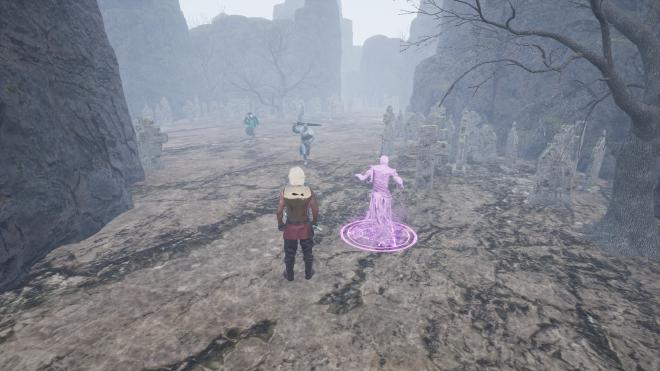
Small groups of Skeleton enemies featuring multiple professions, creating synergy and teaching players to identify enemy roles and behaviors - should most closely simulate a 1:1 ratio battle of Bearers. Medium enemy density with higher utility. Closed and narrow area with scattered objects for cover.
Added mini-boss: Werewolf.
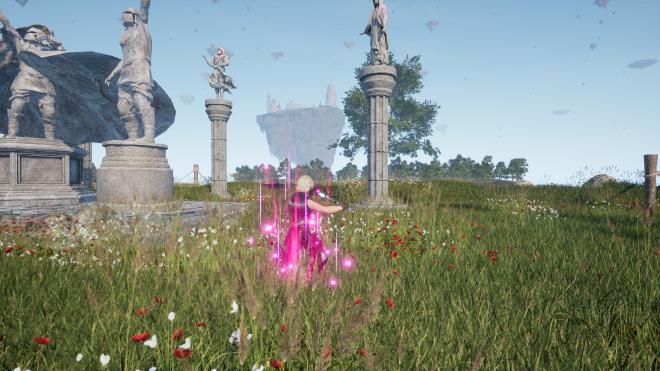
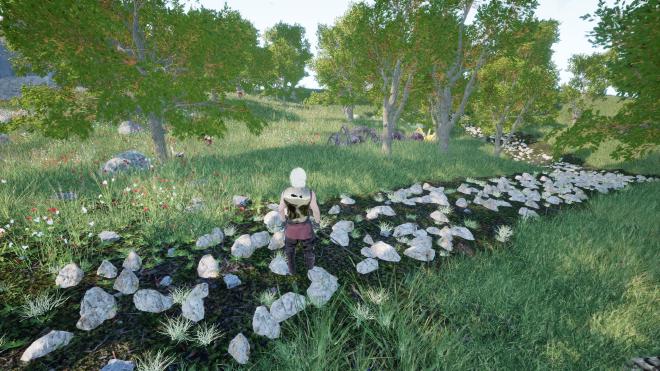
High-density Spider swarms (melee, ranged and healer roles) with low power and some utility, the challenge comes through the overwhelming numbers. This battle scenario should emphasise the value of AoE and proximity damage. Great Worm enemies add ranged crowd control and positional pressure - players must be aware of their general positioning on the map and their aggro range to avoid being overwhelmed.
Added mini-boss: Forest Webstrider.
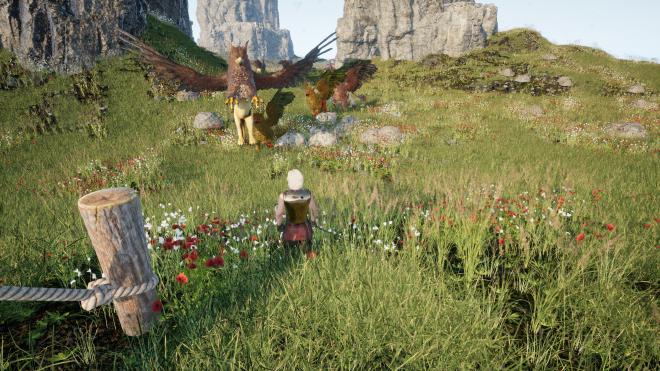
Small numbers of powerful Griffin enemies with high utility, encouraging players to learn enemy abilities, builds and roles to formulate effective strategies. Patrolling mobs require tactical timing based on aggro proximity. Low density, high challenge.
Added mini-boss: Young Dragon.
Whilst not directly related to encounter design, Return Sickness has been added to the game to create some risk and disadvantage from deaths. Previously there was nothing discouraging players from taking a dive off the side of the world, or more importantly, from taking battles with reckless abandon and insurmountable odds.
Now, upon death, Return Sickness reduces Health and Energy by 15% per death. This can be removed 1% at a time by defeating enemies, or by visiting a Shrine (which will also respawn enemies long term).
Another important part of this phase was expanding the ability library to establish clear thematic and mechanical identities for each profession, ensuring players experience distinct playstyles while understanding how abilities interact within certain battle scenarios as well as within certain team compositions. The player can discover the diversity and efficacy of different playstyles based on the challenge at hand.
5+ Standard Abilities - Each set designed to showcase a distinct playstyle signature to that profession
1 Inherent Ability - Demonstrates potential for build synergy and profession-specific mechanics
Profession Resources - Preparation charges that fuel high power/utility abilities, adding resource management depth
Enemy Integration - At least two abilities from each profession implemented in enemy builds, giving players live examples of ability usage and tactical applications
Capturable Abilities - Minimum one capturable ability per profession, ensuring dual-class players have access to at least two capturable abilities during the tutorial phase
Ability Acquisition Changes/Note: Removed non-core abilities from the store, making them capturable only. This change ties ability acquisition directly to enemy encounters, reinforcing the connection between enemy types and their signature abilities while encouraging active engagement with the capture system.
The first iteration of this demo space was built for PAX 2025, establishing a multi-purpose level that would function as a convention demo, the game’s tutorial, and an ongoing testbed for gameplay and balance feedback.
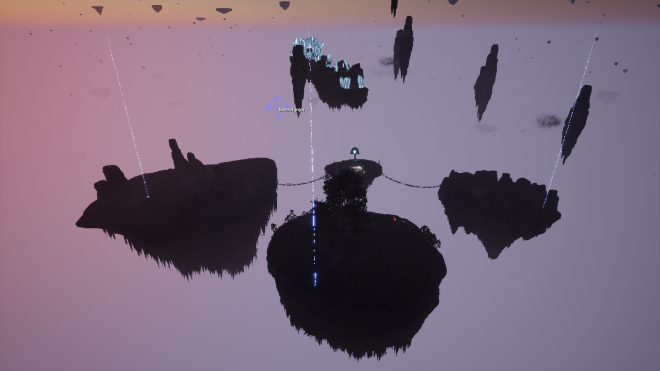
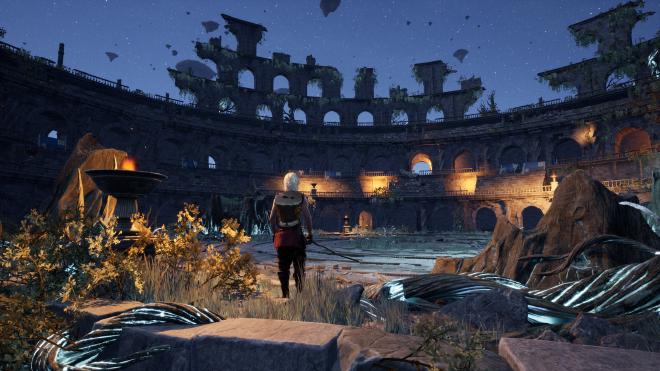
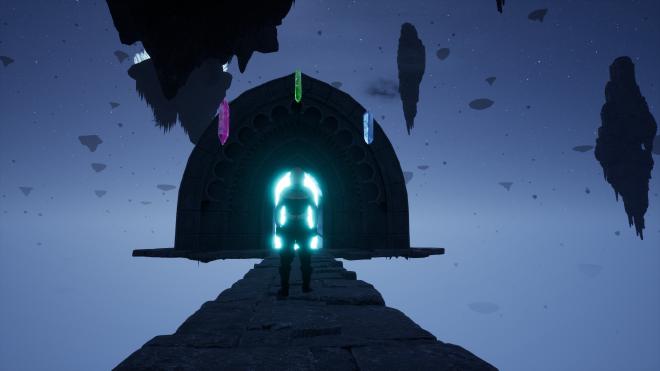
The PAX build featured the profession selection tutorial and three diverse islands for sandbox testing of core gameplay mechanics. While the overall structure envisioned a flow from tutorial through the islands to a final Colosseum boss encounter, the Arena itself remained inaccessible, its portal door visible in the level but without any mechanism to unlock.
Since PAX, development has focused on populating this framework and enriching it with substantial content additions, refining it into a meaningful smaller-scale representation of the full game vision, whilst providing the structure needed to rapidly iterate on weapons, abilities, and combat systems while gathering player feedback at a more frequent cadence going forward.
Activate the crystals to open a portal to the ArenaActivate the crystals to open a portal to the Arena
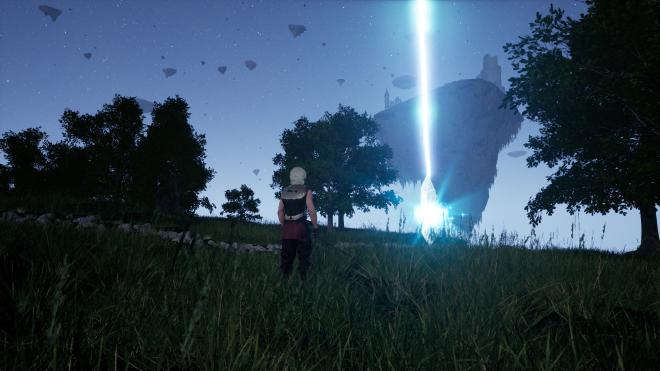
Progressive Tutorial Structure - Players activate three crystals - one from each island (Graveyard, Forest, Rocky) - to unlock the portal door leading to the Colosseum Arena. This progression introduces core mechanics and enemy types before the final challenge.
Persistent Access for Testing - Character progress saves the portal unlock state, allowing returning testers to bypass the tutorial if desired. Since enemies respawn when resting at shrines, the three islands remain available for testing abilities across different combat scenarios and enemy compositions. For focused balance testing without environmental variables, the Arena provides a controlled space.
Flexible Arena Configuration - The Arena serves as a modular testing space where bosses, mini-bosses, standard mobs, or any combination thereof can be deployed. This flexibility allows an isolation of specific encounters for balance testing or creating custom scenarios for targeted feedback.
The focus moving forward is to enter a more rigorous stage of testing and refinement, moving towards this space acting as a fully encapsulated representation of the game - a complete vertical slice that gives players a genuine feel for the combat depth, build diversity, and tactical decision-making at the heart of the experience. With continued polish and content additions, we hope this demo has the potential to serve as a wide public release for an upcoming Steam Next Fest, showcasing what makes Bearers distinct while gathering valuable feedback from a broader player base before committing to full-scale world and narrative development.